The test methods are ASTM E96 (Wet Cup) or BS 7209:1990 (Evaporative Dish). They are comparative tests and do not represent “real world” exposure. They simply show the relative differences between fabrics in a laboratory environment.
Mid-range MVTR’s are about 5,000 g/m2/24h however to be most effective they should be around 20,000 g/m2/24h. This is a very slow process and its effectiveness is heavily dependent on environmental conditions especially temperature & humidity and the stability of those conditions over extended periods. This is why lower rates than 5,000 have little or no effect even in the best conditions.
Important Note: The outdoor environment is always seeking equilibrium therefore this “wicking” action allows moisture vapor to migrate in both directions so if conditions are conducive a wet environment under a cover will try and migrate to the outside and the reverse if the outside is the wetter environment.
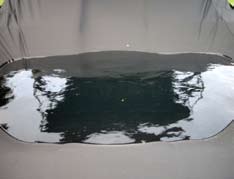
Rain resistance is measured as a hydrostatic head in centimeters (cm). This indicates the pressure of water needed to penetrate a fabric. Heavy or wind-driven rain has a higher pressure than light rain. The test method is ASTM 127-98 where a column is placed over the face of the fabric and filled with water until it begins to drip through the backside of the fabric. It is measured in Centimeters and the higher the CM reading the higher the hydrostatic water resistance.
Conversely, fabrics with high MVTR’s have very low Hydrostatic water resistance as they are opposing characteristics. Fabric with a hydrostatic head rating of 100 cm or less is regarded as shower resistant, with 150 cm usually being suitable for maintaining a dry condition.
Pooling water will eventually seep through fabric on low Hydrostatic rated fabrics.
| Typical Acrylic Polyesters | Hydrostatic Resistance | 45 cm | MVTR – 1,500 g/m2/24h |
| balanced weave fabric | Hydrostatic Resistance | 163 cm | MVTR – 500 g/m2 /24h |
An absolute feature of a Mooring Cover is that it repels water and resists penetration so effectively the boat interior doesn’t get wet during a rain storm. The benefit of low MVTR’s is marginal at best and the highest Hydrostatic rate is more important to effectively protect the boats interior.
This is why we created balanced weave fabric. It has the highest Hydrostatic resistance of any other fabric so it will prevent water from penetrating our cover even under severe “pooling” and maintain the ability for 3-4 times longer that other fabrics.