
Understanding Price, Functionality, and Long-Term Value
When a boat builder looks at two covers that appear to do basically the same thing, it is fair to ask why one costs a few hundred dollars and another can cost well over $1,000. They both cover the boat, so what is actually driving the difference? More importantly, is the additional cost creating real value, or are you simply paying more for what appears to be the same product?
The answer comes down to what you expect the cover to do.
Since 1967, Commercial Sewing has designed and manufactured sewn goods for the outdoor recreation industry. Over nearly 60 years, the company has produced more than 500,000 part numbers and holds approximately 30 active patents covering innovations in marine and powersports products.
A boat cover can be a relatively simple piece of protection for a boat sitting in storage, or it can be a highly engineered product designed specifically around the boat, its options, how the owner uses it, and the environment it will experience. In this article, we will explain what drives those cost differences, where the additional value comes from, and what boat builders should look at when deciding how much performance they really need from a cover.
How do Boat Covers Compare in Cost?
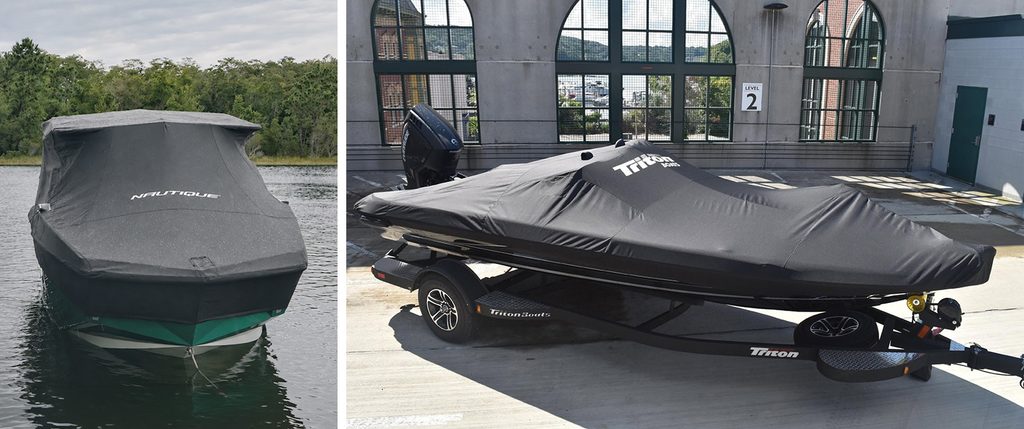
For a basic 20-foot runabout, a general-purpose or semi-custom cover might retail in the range of $200 to $500. For an owner primarily looking for basic storage protection without requiring an exact fit or trailering capability, that may be all they need.
A custom cover can range from approximately $500 to $2,000 at retail, depending on the size and complexity of the boat, the material, the attachment and tensioning system, the ease of installation, whether it needs to be trailerable, and how much engineering goes into creating the fit and functionality.
That is why comparing covers strictly by price can be misleading.
The difference may not be obvious when the covers are sitting in a box. It becomes much more apparent after they have been installed hundreds of times, exposed to sun and rain, subjected to highway trailering, or used across boats with different towers, bimini tops, electronics, furniture arrangements, and accessories. Two covers can look similar and perform very differently.
How Does Custom Fitment Affect Boat Cover Cost?
One of the biggest differences between a basic cover and a premium custom cover is the amount of engineering that goes into fitment.
Every boat presents its own challenges. A wake boat may have a tower, speakers, board racks, windshield, and multiple areas susceptible to abrasion. A pontoon has a long perimeter along with gates, furniture, rails, and different bimini configurations. A bass boat may have trolling motors, consoles, electronics, and other deck-mounted equipment that all affect how the cover fits.
Then you have differences within the same boat model. One option package may fit differently than another. Changing a tower, windshield, furniture arrangement, electronics package, or bimini location can alter how tension moves across the cover. This is where precision engineering matters.
At Commercial Sewing, we look at the geometry of the actual boat and its different configurations. The development process can include CAD data, pattern development, prototypes, physical fitment, installation evaluations, and product validation. The objective is not simply to make the fabric look tight. It is to control how the cover interacts with the boat.
A precise fit helps the cover shed water properly, reduces unnecessary fabric movement, helps protect vulnerable surfaces from abrasion, creates more predictable tension, and makes installation more repeatable. That engineering has a cost. It also has a purpose.
How Does Installation and Ease of Use Affect the Price of a Boat Cover?
A cover can provide excellent protection once installed, but if putting it on is difficult enough that the owner avoids using it, much of that value disappears. This is one of the areas where we have spent considerable engineering time at Commercial Sewing.
Traditional covers can involve multiple snaps, poles, clips, and straps. There is nothing inherently wrong with those systems, and they can work very well. The issue is that every additional step creates another opportunity for the cover to be installed incorrectly, for tension to be uneven, or for a component to be lost or damaged.
Our approach has been to ask a different question: how can we engineer the cover to make the owner’s job easier?
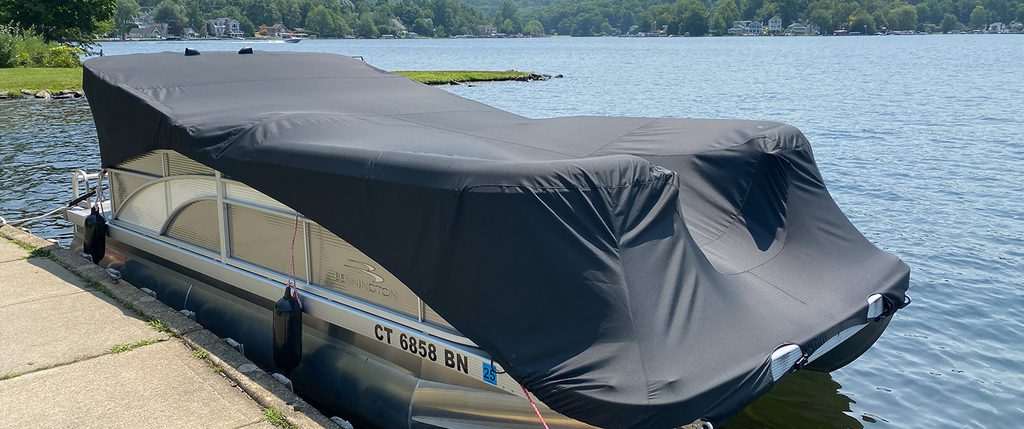
One example is the front-ratchet pontoon cover system developed by Commercial Sewing. In the specified application, the system is designed around an installation target of less than three minutes. The cover is installed from the stern toward the bow, allowing the owner to finish the installation and exit from the front of the boat. It’s where most people get on and off the boat!
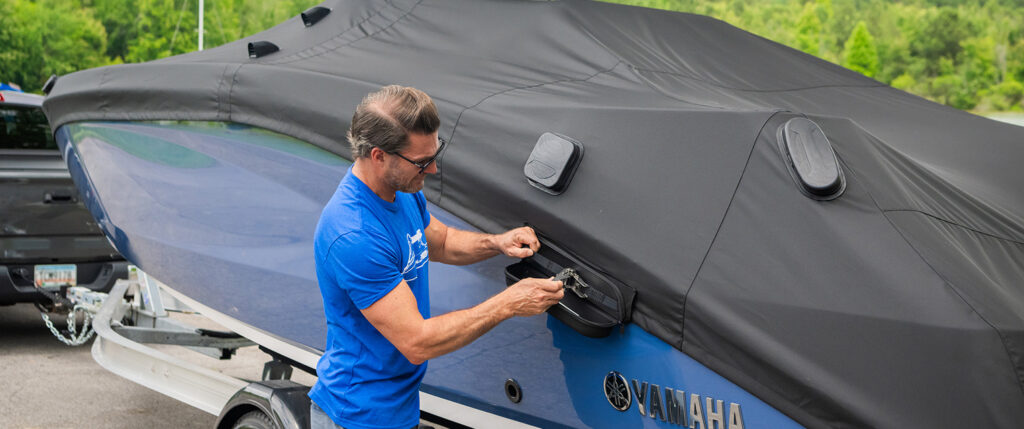
The composite ratchet is integrated into the tensioning system so the installer can consistently apply tension around the perimeter of the cover. On applicable versions, a force indicator helps the installer know when the appropriate tension has been achieved. What looks like a simple ratchet to the customer is actually part of a larger engineered system.
The ratchet location, tension, cover pattern, attachment points, fabric properties, deck hardware, bimini structure, and abrasion areas all have to work together. If one of those elements is wrong, issues like water pooling may occur. That is the difference between adding a feature and engineering a solution.
How Does Water Management Affect Boat Cover Cost and Value?
Water is another good example of why fit and engineering matter.
You might think that keeping water out of a boat is primarily about choosing waterproof or water-resistant fabric. The reality is more complicated. The cover has to move water off the boat.
If the geometry creates low spots, water begins to accumulate. As the weight increases, the fabric stretches further and the low spot becomes deeper. That additional load can place stress on seams, attachment points, poles, and other components. Over time, what started as a small fit issue can turn into a significant performance problem.
Good water shedding requires the pattern, material, tension, support locations, attachment system, and underlying boat configuration to work together.
The cover also has to continue functioning after repeated installation and exposure. A product that looks great during the first fit evaluation but begins pooling six months later is not a successful design.
That is why we look at water management as part of engineering the entire cover, rather than addressing it as a separate feature.
How Much More Does a Trailerable Boat Cover Cost?
Trailering raises the performance requirement significantly.
A cover sitting on a boat at a marina does not experience the same forces as a cover traveling at highway speeds. Air moving over and underneath the cover can cause the material to lift, balloon, move, and repeatedly contact the boat. That movement matters. Over time it can wear fabric, stress seams and attachment points, or create abrasion against painted and finished surfaces.
A cover should not be considered trailerable simply because it has enough straps to remain attached to the boat. A properly engineered trailerable cover requires the fit, tension, attachment locations, reinforcement, abrasion protection, material, and airflow management to function together. It also needs to be evaluated on the actual boat configuration and under the intended transportation conditions.
This is why Commercial Sewing developed Vacu-Hold venting for applicable trailerable cover systems. The vents help manage airflow beneath the cover to create a more stable profile and reduce the billowing and movement that can occur at highway speeds. Commercial Sewing identifies Vacu-Hold and ratchet-tensioned systems among its patented cover technologies.
Again, the vent itself is only part of the solution. Its location has to work with the geometry and tension of the cover. Fit, attachment, material selection, and airflow all have to work as a system. That engineering and validation add cost, but they also create functionality that a basic storage cover does not require.
How Does Material Selection Affect Boat Cover Pricing?
Another common way to compare covers is by looking at the fabric specification. That is important, but fabric weight or thickness by itself does not tell you how the finished cover will perform.
A marine cover material has to deal with UV exposure, moisture, heat, abrasion, repeated installation, folding, tension, and in some applications, the forces associated with trailering. Thread, reinforcement materials, hardware, coatings, and construction methods also influence how the product performs over time.
Material development has become even more important as the industry transitions toward PFAS-free solutions. Moving to a PFAS-free material is not simply a matter of replacing one fabric with another. The new material still has to provide the water resistance, durability, appearance, dimensional stability, sewability, color performance, and outdoor-life characteristics expected from the original product. That requires testing.
Commercial Sewing has dedicated PFAS material and component development and quality-testing capabilities because we believe these decisions should be based on actual performance, not simply on a specification sheet. A fabric may meet an individual laboratory specification and still not be the right material for a particular cover. Ultimately, the material has to perform as part of the finished product.
How Do Boat Features and Configurations Affect Custom Cover Pricing?
Modern boats continue to become more complex, and every addition to the boat creates something else the cover has to accommodate.
A tower or windshield can concentrate tension into a relatively small area. A trolling motor creates a different profile and potential abrasion point. A pontoon bimini changes the geometry of the cover. Electronics, cleats, rails, consoles, furniture, ladders, and other accessories all influence how the material fits and where it makes contact with the boat.
There are two basic ways to deal with these differences. One is to make the cover sufficiently generic that it loosely accommodates a wider variety of configurations. That reduces development costs, but the tradeoff can be additional material, looser areas, more opportunity for movement, and less control over water shedding. The other approach is to engineer the cover around the configurations it is actually expected to protect. That requires more development work and potentially additional patterns or part numbers, but it gives the designer greater control over tension, clearance, reinforcement, and fit. Neither approach is automatically wrong. The important issue is understanding what you are paying for and whether it matches the expectation of the boat and the customer.
Does a More Durable Boat Cover Cost More?
We often hear durability discussed primarily as a material issue. In reality, some of the most durable fabric available can still fail relatively quickly if the cover has been designed incorrectly.
If tension is concentrated in one location, something eventually has to give. If a seam is positioned against an abrasion point, repeated movement will cause wear. If the cover is too loose during trailering, fabric movement can significantly reduce its life. If water continually pools in the same location, the load affects the entire structure around that point.
Long-term durability comes from understanding how all of these elements interact. The fabric, thread, reinforcement, seams, attachment system, tension, fit, and use conditions need to be engineered as one product. This is where experience has real value.
Why Do Boat Cover Suppliers Charge Different Prices?
Not every boat cover needs the same level of engineering.
If an application is relatively simple and the primary objective is to hit a lower price point, it may make sense to use a standardized attachment system, simplify the pattern, reduce the number of prototypes, or minimize application-specific testing. That can result in a perfectly acceptable cover for that application. Other applications require more.
A manufacturer may invest significantly more time in early engineering, CAD development, prototypes, physical fitment, installation studies, proprietary components, material development, trailering validation, configuration-specific protection, quality controls, and engineering support. All of those activities cost money.
The reason for doing them is not to make the cover more complicated or more expensive. It is to solve problems before the customer encounters them. That is an important distinction.
A lower-cost product is a good value when it meets the customer’s requirements. A higher-cost product is a good value when the additional engineering and features provide functionality the customer actually needs. Cost becomes a problem when the product does not perform as expected.
What Should You Expect From a Quality Boat Cover Supplier?
Commercial Sewing has been designing and manufacturing custom sewn products since 1967. Over that time, the company has expanded beyond its Torrington, Connecticut roots and developed technologies addressing fit, tensioning, installation, water management, and trailering.
What we have learned is that there is rarely one individual feature that makes a good cover.
It is usually the combination of many small details. The fit has to work with the boat. The material has to work with the intended environment. The tension needs to be controllable and repeatable. Water needs somewhere to go. The installation process has to make sense to the person actually using the cover. If it is trailerable, airflow and abrasion have to be considered. And when the boat manufacturer changes something on the boat, the cover has to change with it. That is where we believe Commercial Sewing creates value.
Our approach has always been centered on precise engineering and fitment, long-term durability, innovative features that make covers easier to use, trailerability, and continued material development and testing. We do not believe every application needs the most expensive solution. We do believe the cover should be engineered for what the customer expects it to do.
How Should a Boat Builder Compare Two Cover Quotes?
When two suppliers are quoting what appears to be the same cover, make sure they are actually quoting the same level of performance.
Start with the intended use of the cover. Is it for basic storage, outdoor mooring, trailering, or some combination? Then look at which boat models and option configurations the supplier is designing around. Ask how the fit is developed and validated, how the cover manages water, how long installation takes, and whether the process is realistic for the dealer or owner who will actually use it.
If trailering is required, ask how the design was validated and on which configurations. Look at the material and reinforcements, but also consider how tension and abrasion are managed. Understand what testing has been completed and what happens when the OEM changes a tower, bimini, piece of furniture, or other component after the cover has been developed.
Finally, look beyond the original quote and consider what happens after production starts.
If a lower-cost cover continually requires dealer adjustments, warranty replacements, engineering involvement, or customer-service support, those costs do not appear in the original unit price. A $25 or $50 savings per cover can disappear quickly if the product creates recurring problems downstream.
Is a More Expensive Boat Cover Worth the Investment?
Sometimes it is. Sometimes it isn’t.
A basic $200 to $500 retail price cover can be exactly the right solution for a 20-foot runabout when the primary requirement is straightforward storage protection. Moving into the $500 to $2,000 retail price range for a custom cover can make sense when the customer expects precise fitment, easier installation, better water management, premium materials, boat-specific protection, longer-term durability, or validated trailering capability.
The mistake is assuming price alone tells you which cover represents the better value.
A more expensive cover should be able to demonstrate what the additional investment provides. Is it easier to install? Does it fit better? Does it shed water more effectively? Is it designed and validated for trailering? Does it better protect the boat’s surfaces and equipment? Will the material and construction withstand the intended environment? Has the supplier demonstrated that the system works?
Those are much better questions than simply asking which cover costs less.
At Commercial Sewing, we have spent nearly 60 years engineering covers and other custom sewn products around those questions. Our objective is not to build the most expensive cover. It is to understand how the product will actually be used and then engineer the fit, materials, components, and features necessary to make it work. The best value is not necessarily the least expensive cover. It is the cover that delivers the functionality the customer needs, protects the boat the way it was intended, and continues doing its job over the life of the product.
Boat Builders – If you are looking for more information or are interested in having Commercial Sewing design a custom cover for your boat line, please contact our sales department using our contact form.