
What Air Permeability Really Means
The simple answer: Not in the way most people think. Fabric “breathability,” which is measured as air permeability, only matters when wind pressure pushes air through the cloth. A boat sitting covered at a slip or on a trailer has almost no pressure on it, so air doesn’t meaningfully pass through the fabric no matter how “breathable” it is. Vents move far more air than fabric does. And when you’re towing, a highly air-permeable cover actually works against you. It billows, buffets, and wears out faster.
“Breathable” is one of those words that sounds good in a product description. Breathable rain jackets, breathable mattresses, breathable boat covers. Nobody wants to be the person who bought the cover that suffocates their boat.
But the word gets used to mean two different things, and that’s where boat owners get steered wrong. Let’s separate them.
What does “breathable” actually mean for fabric?
In textile testing, breathability usually means one of two properties:
- Air permeability: how much air (think wind) passes through a fabric in a given time when pressure is applied.
- Moisture vapor transfer: how readily water vapor passes through the fabric, the property that keeps a rain shell from feeling like a plastic bag. We cover that one in our bulletin on moisture vapor transfer and sweat-through rate.
This post is about the first one, air permeability. The key detail is easy to miss: it’s a dynamic property. Air only moves through fabric when something is pushing it. No pressure, no flow.
How is air permeability measured?
The standard lab method is ASTM D737, the Standard Test Method for Air Permeability of Textile Fabrics. A conditioned fabric sample is clamped into a machine (often called a Frazier-type tester) that draws air through it at a set pressure difference, measured in pascals. The result is reported as airflow, commonly in cubic feet per minute (CFM) through a given area.
Notice what the test needs in order to produce a number: a fan creating pressure. That’s the whole point. The test measures how fabric behaves when wind is hitting it.
Where does air permeability really matter?
Air permeability is a big deal in products that live under wind load. Outerwear needs to block wind so you stay warm. Sails, parachutes, and airbags are designed around how much air the fabric holds or releases. In all of those, the fabric is working against moving air.
It’s also a trade-off. Fabrics with high air permeability generally have lower water repellency. A more open structure lets air through, and it tends to let water through more easily, too. For a cover whose main job is keeping rain, snow, and spray off your boat, that matters.
Does a boat cover need to breathe when the boat is just sitting there?
This is where the marketing and the physics part ways.
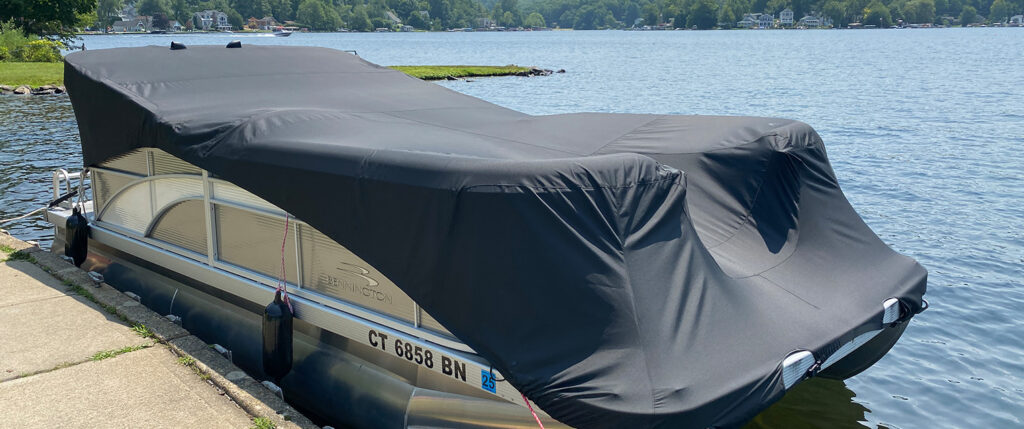
When your boat is covered at the slip, on a mooring, or parked on a trailer, there’s essentially no pressure difference across the cover. The air underneath is mostly stagnant. Because air permeability depends on pressure, very little air is passing through the fabric itself, whether the fabric is rated as highly permeable or barely permeable.
Here’s an analogy. A screen door is wonderfully “breathable.” But on a dead-still August night, the house stays stuffy anyway. The screen isn’t the problem. There’s just nothing moving the air. Open a window across the room so air has a path, and things change. On a boat cover, vents are that open window. They move far more air than the fabric does.
So the real question isn’t “how breathable is the fabric?” It’s “how does air and moisture move in and out of the covered space?” That’s a ventilation and moisture-management question, not a fabric question.
What about mildew and condensation?
Most boaters who ask about breathability are really worried about dampness. That’s a fair worry. BoatUS points out that unattended boats build up humidity as air, water, and hull temperatures change, and that trapped moisture creates ideal conditions for mold.
But the fix isn’t a leakier fabric. Wetness under a good cover is usually condensation, not a leak. It forms when air and surfaces under the cover cool below the dew point overnight. The habits that make the biggest difference are practical ones:
- Clean and fully dry the boat before you cover it.
- Put desiccant bags in the cockpit and lockers.
- Fit the cover snugly so outside humid air isn’t constantly swapping in.
We go deeper on this, including when it makes sense to close off the vents during storage, in our bulletin on condensation: cause and prevention.
Why does a breathable boat cover billow when you tow?
Now flip the situation. You’re towing at highway speed, and suddenly there’s plenty of pressure. Wind is hitting the cover hard.
If the fabric is highly air permeable, air pushes through it into the space under the cover. That trapped air inflates the cover like a balloon. The cover billows, then snaps back, then billows again. That repeated buffeting:
- wears out seams, straps, and the fabric itself much faster,
- can chafe the boat’s finish, windshield, and hardware, and
- sometimes ends with a cover that’s no longer on the boat.
This is the moment when air permeability actually shows up, and you want less of it, not more.
How Outer Armor covers handle it
Our mooring covers use a lightweight, high-strength fabric with a balanced weave, so the cover resists wind instead of filling with it. Patented VacUHold® vents sit near the top of the windshield area. When air rushes over them while towing, they help draw the cover down onto the boat instead of letting it balloon. It’s the same principle as an airplane wing, pointed in a useful direction. You can see how the design comes together on our mooring covers page.
At rest vs. towing: what actually moves the air?
| Situation | Pressure on the cover | Air through the fabric? | What actually matters |
|---|---|---|---|
| Covered at the slip or mooring | Little to none | Negligible, regardless of fabric rating | Drying the boat first, desiccants, snug fit, smart use of vents |
| Parked on a trailer | Little to none (light breeze at most) | Negligible | Same as above, plus preventing pooled water |
| Towing at highway speed | High | Yes, and too much causes billowing and buffeting | Low-permeability, tightly woven fabric; vents that pull the cover down |
| Storm or high winds at the dock | Moderate to high, gusting | Some | Strong fabric, secure fit, and tie-downs |
What should you look for instead of “breathable”?
If you’re comparing covers, here’s a more useful checklist than one marketing word:
| Instead of asking… | Ask this |
|---|---|
| “Is the fabric breathable?” | “How does the cover vent, and can I control the vents?” |
| “Will it stop mildew?” | “Does it shed water well, and what’s the plan for condensation?” |
| “Is it trailerable?” | “How does it behave at highway speed? Does it balloon?” |
| “Is it waterproof?” | “What’s the trade-off between water resistance and air permeability in this fabric?” |
Our fabric guide walks through how we choose cover materials with those trade-offs in mind.
The deeper answer
“Breathable” isn’t a bad word. It’s just an incomplete one. Fabric breathability, in the air permeability sense, is about wind resistance. For a boat cover, it rarely helps at rest and actively hurts on the highway. What keeps a covered boat dry and healthy is a combination of water-shedding fabric, a good fit, real vents, and a few simple habits before you walk away from the dock.
If a cover’s main selling point is that it breathes, it’s worth asking a follow-up question: breathes how, and when?
Frequently asked questions
Is a breathable boat cover better for preventing mildew?
Not by itself. With no wind pressure, very little air passes through any cover fabric. Mildew prevention comes from storing the boat clean and dry, using desiccants, keeping the cover snug, and managing vents. See our condensation bulletin for specifics.
What is air permeability in fabric?
Air permeability is the rate at which air passes through a fabric under a set pressure difference. It’s typically tested using ASTM D737 and reported as airflow, such as CFM, through a given area.
Why does my boat cover balloon when I’m towing?
Wind pressure pushes air through and under the cover faster than it can escape, so the cover inflates and buffets. A tighter-weave, low-permeability fabric and vents designed to pull the cover down both reduce billowing.
Do boat cover vents really make a difference?
Yes. Vents move far more air than the fabric itself. They’re the main path for air exchange when the boat is stored, and well-designed vents also help hold a cover down while towing.
Is a waterproof boat cover the same as a non-breathable one?
Not exactly. Water resistance and air permeability are separate properties, though they often trade off: more open, air-permeable fabrics usually repel water less well. A good cover fabric balances strength, water resistance, and low air permeability.
Have questions about your cover?
Outer Armor covers are designed, tested, and built by Commercial Sewing in Torrington, Connecticut, and our engineers write these technical bulletins because boaters ask us these questions every week. If you’d like help choosing a cover for how you actually use your boat, browse our mooring covers, read more of our technical bulletins, or contact our team. You can also reach us at 860.482.5509 or visit us at 65 Grant Street, Torrington, CT 06790.
This article is adapted from Commercial Sewing Technical Bulletin CS-03, Breathability of Fabrics: Air Permeability.